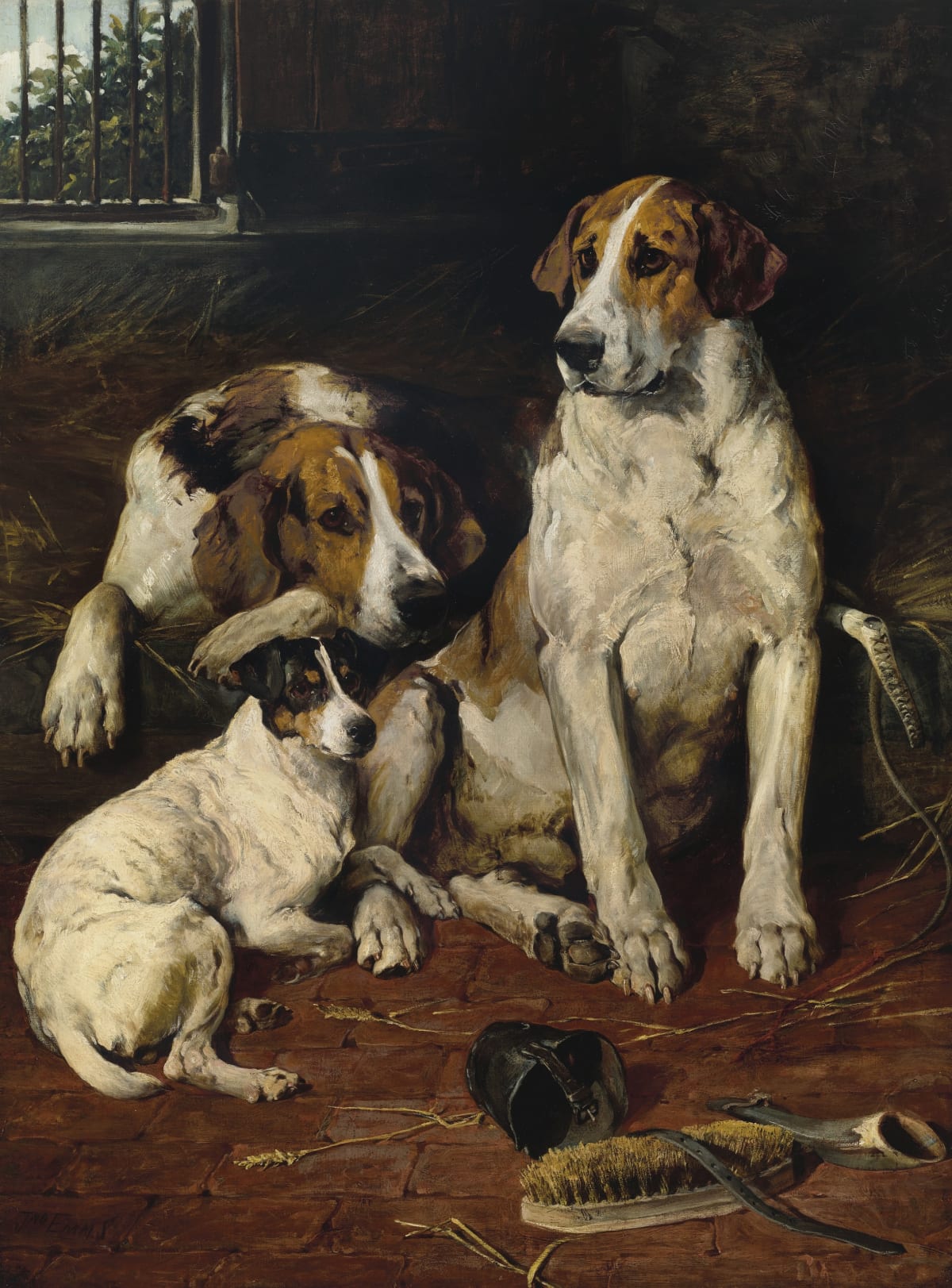
John Emms painted hounds the way Munnings painted them — but slower. Not the chase. The hour after. Foxhounds folded into stable straw with their tongues out and their ribs still working. Terriers asleep against a kennel door. The moment between the hunt and dinner, painted hundreds of times across a single working life in the New Forest.
He's the painter you can't quite name but absolutely recognise. If you've ever walked into an English country house and noticed an old oil of foxhounds stretched out on the floor of a brick-walled kennel — warm browns, a shaft of stable light, one hound with its head up and the rest dead asleep — there's a very good chance you were looking at a John Emms. He painted that scene, in one variation or another, until he died. He was prolific to the point that many of his canvases left his Lyndhurst studio for the local hunts and the local gentry without ever passing through an auction house. The aesthetic outlived the attribution.
A Life in Brief — Norfolk, Leighton, and the New Forest
John Emms was born in 1844 in Blofield, Norfolk, the son of the painter Henry William Emms. He grew up with paint in the house, which is the simplest explanation for how naturally his hand moved by the time he was working professionally. His apprenticeship, when it came, was unusually grand: he went to London and worked as a studio assistant to Frederic, Lord Leighton — the future President of the Royal Academy. In the early 1860s Emms accompanied Leighton down to Hampshire, where he is thought to have helped on the fresco The Wise and Foolish Virgins in the parish church at Lyndhurst.
He never really left. By 1872 he was dividing his time between London and the New Forest. After his marriage to Fanny Primmer of Lyndhurst in 1880 he moved permanently, building a large house and studio called The Firs on the edge of the village. From there he painted, more or less continuously, for the next thirty years — hunting scenes for the New Forest Foxhounds, kennel studies for the Meath, terrier portraits for whichever local family had brought a dog up to the door that week.
He exhibited at the Royal Academy from 1866 onwards. He was admired in his lifetime for the vitality of his animals and was in steady demand as a sporting portraitist across the country. He died at The Firs on 1 November 1912, having painted, by most estimates, several hundred canvases.
What Made the Emms Style Different
Most Victorian sporting painters did the careful thing. Tight finish. Composed studio backdrop. The hound posed like a guardsman.
Emms went the other way at three points at once.
He painted fast. His brushwork is loose, confident, and built for atmosphere rather than for inventory. You can see the bristle marks on the flank of a sleeping hound. You can see where he laid in the straw with three quick strokes and decided it was enough. The looseness isn't carelessness — it's the same trick Munnings would later perfect in outdoor light. Speed forces the painter to commit to the impression of the animal rather than its catalogue, and that impression is what reads as life on the canvas.
He painted warm. The Emms palette is brown, tan, ochre, straw, and the dull red of brick. There is almost no cool light in his interiors. A typical Emms kennel scene glows the colour of a low fire — golden on the hounds' coats, deeper amber in the shadow under the bench, a single cooler note where the door is open onto a winter morning outside.
He painted dogs at rest. This is the real signature. Edwin Landseer painted dogs as moral subjects. Stubbs painted them as anatomical subjects. Munnings painted them at work. Emms painted them in the moment between — collapsed in straw with their work just done, ribs heaving, eyes half-closed, the heroic part of the day already behind them. That moment is the entire emotional core of his catalogue.
It's an honest way to paint a working dog. It's also, quietly, the most affectionate.
The Famous Paintings — Hounds, Kennels, and a Dandie Dinmont in Edinburgh
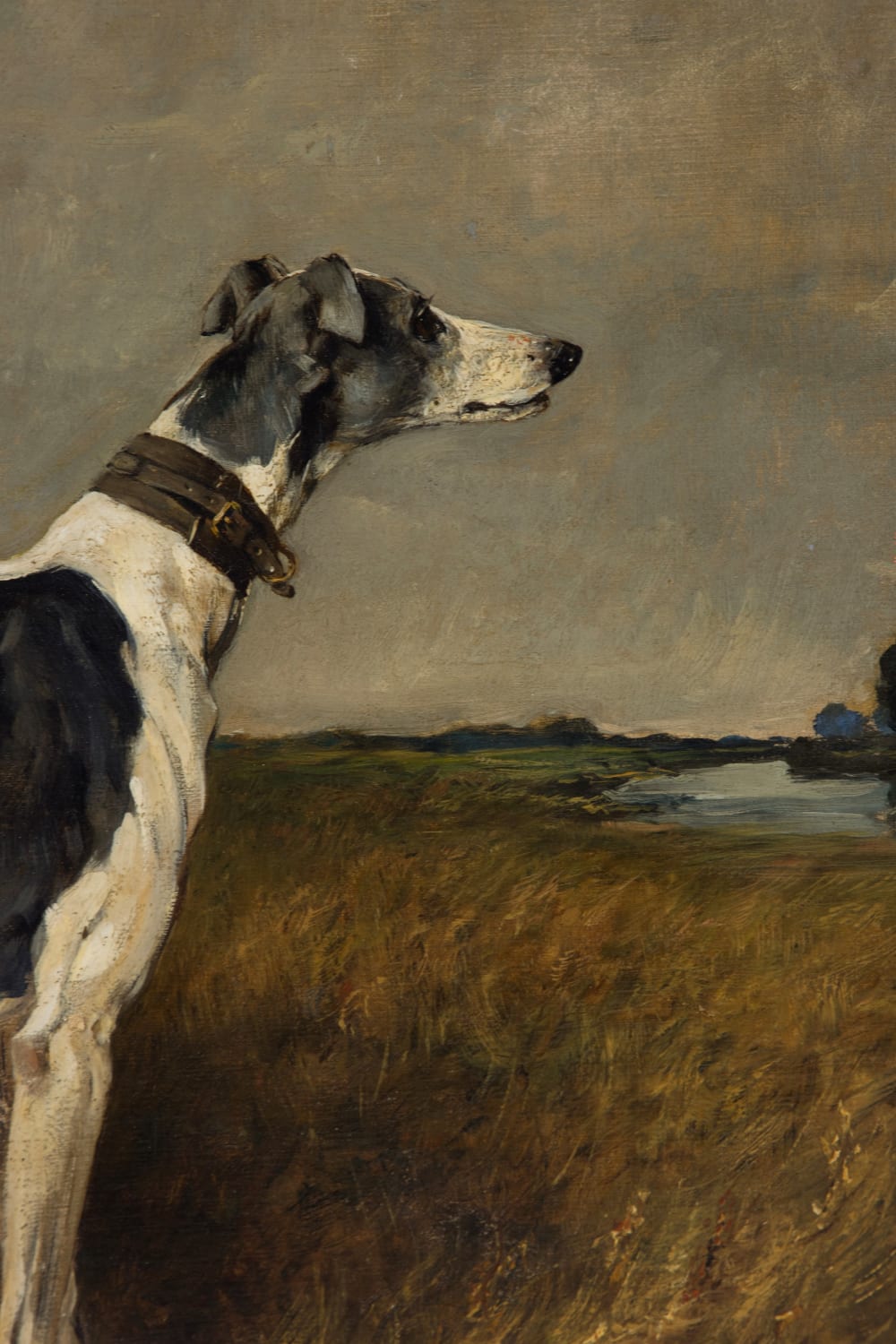
Emms worked in series rather than in landmark canvases, which is part of why his name doesn't carry the way Stubbs or Landseer does. But several pictures and groups are worth knowing.
Callum (1895), National Galleries of Scotland. A portrait of a Dandie Dinmont Terrier, head-up, alert, painted with the same warm brown palette he used for his foxhounds but at much closer range. The most-visited single Emms in any public collection.
The New Forest Foxhounds. A large kennel piece of the local pack he painted for years. Valued in the high six and low seven figures by the AKC's catalogue of sporting art — a fair indicator of the room a major Emms occupies in the market today.
The Bitch Pack of the Meath Foxhounds. A long horizontal canvas of the Irish hunt's pack at rest. The composition is the classic Emms arrangement — eight or ten hounds spilling across the foreground, one or two heads turned toward the viewer, the rest folded into one another in the warm half-light of the kennel.
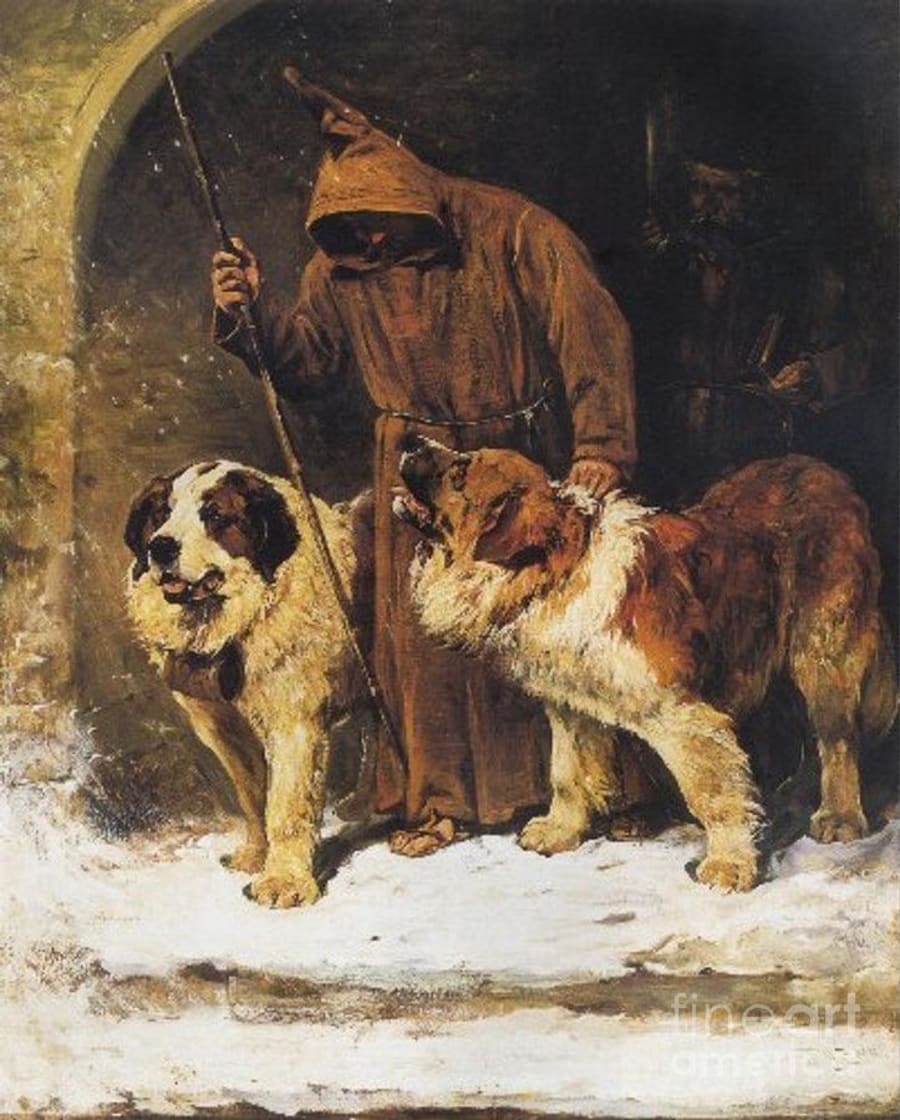
St. Bernards — To The Rescue. One of the relatively few Emms canvases that leaves the kennel altogether. A pair of working St. Bernards in the high mountain pass, the kind of dramatic-rescue subject that Landseer had made famous half a century earlier. Emms's version is looser, browner, less moralized — the dogs are working, not posing for moral instruction.
Hounds by a Kennel, Foxhounds at a Kennel Door, Two Hounds and a Terrier in a Kennel. These are titles given by later auction houses to a whole category of small-to-medium kennel studies that Emms produced in volume throughout the 1880s and 90s. They are the spine of his catalogue. Most country-house Emmses are works in this group — like the hero piece at the top of this article and the foxhound portrait above.
The Country-House Tradition
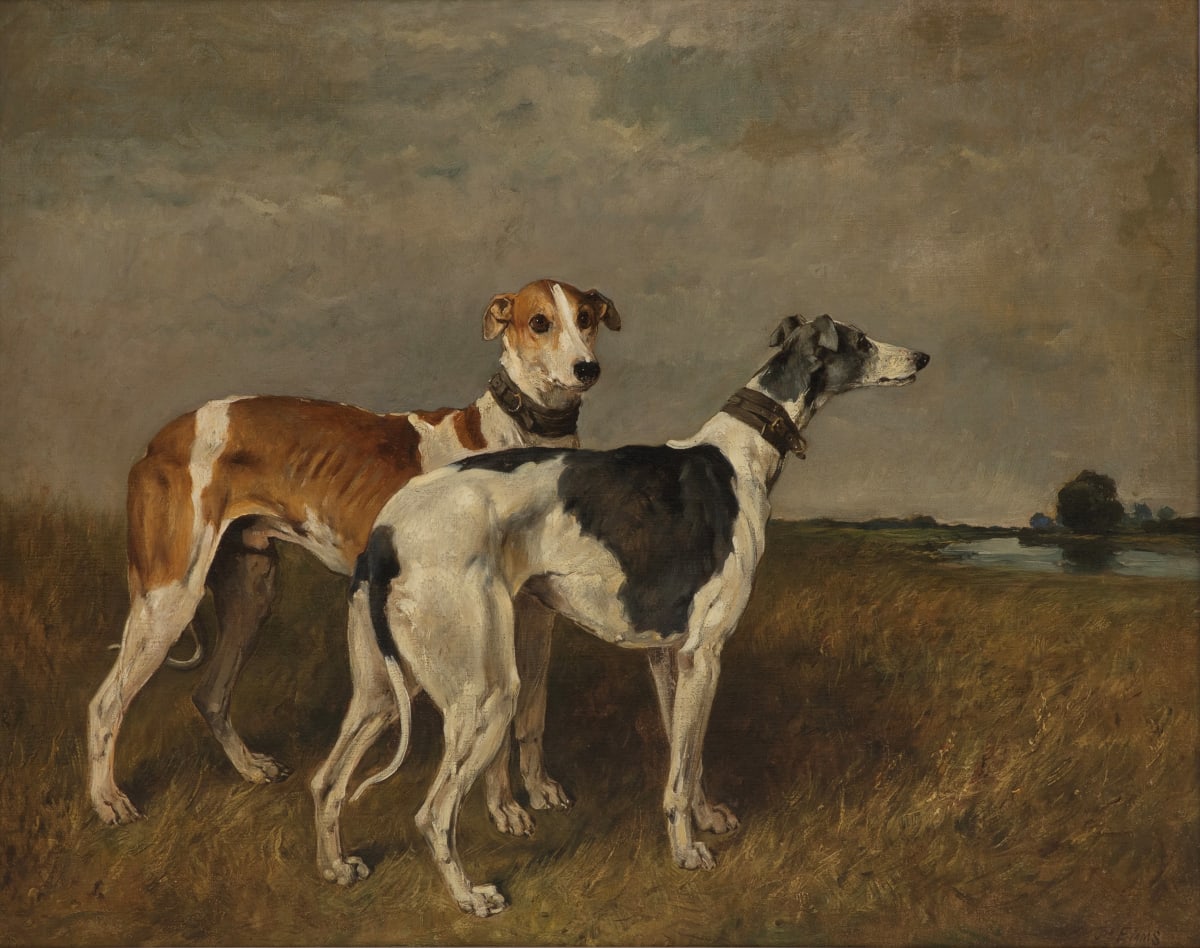
There is a particular aesthetic that lives in old English country houses — and in the American houses that have borrowed from them — and Emms, more than anyone, is the painter who established it. Brick-walled kennel. Hounds in straw. A muddy terrier looking up from the floor. The painting hangs in a back hall or above a sideboard in the boot room. It has been in the family for three generations and the name on the brass plate, if there is a brass plate, says Emms, or sometimes nothing at all.
He sold so many canvases directly to local hunts, masters of foxhounds, and Hampshire gentry that a large fraction of his output never went through the Victorian auction system. Which means there are still, today, hundreds of Emmses on private walls that have never been catalogued. The look outlived the paperwork. When an interior designer says "country-house dog portrait" — that warm, brown, kennel-light, hounds-at-rest aesthetic — the reference is John Emms whether anyone in the room can name him or not.
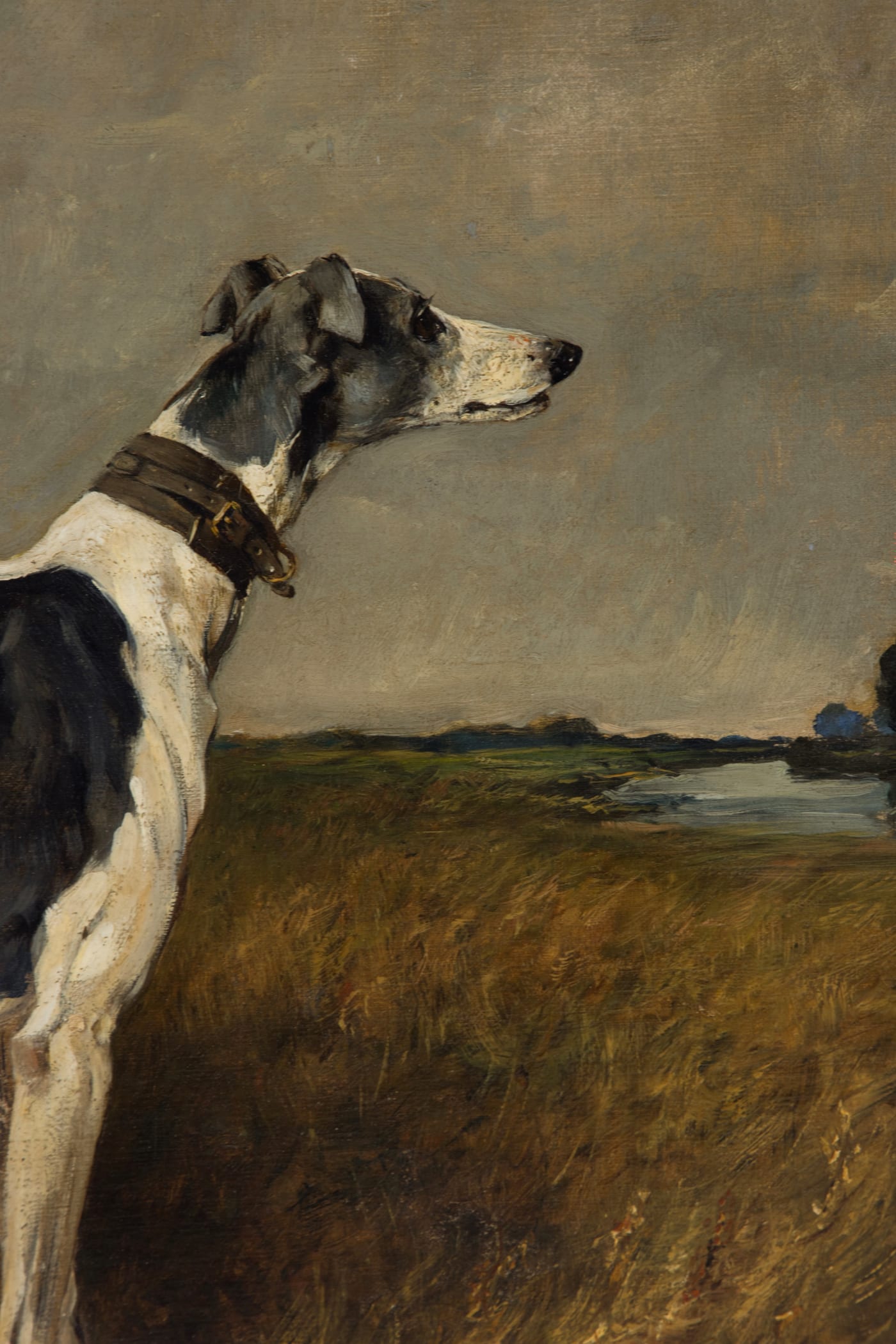
The other sporting painters defined the high end of the tradition. Emms is the tradition.
The Emms Tradition Today — The Working Dog at Rest
This is the painter for the working-dog owner.
The setter that will not stop hunting in its sleep. The spaniel asleep across your boots after a long walk. The retriever in the back of the car with mud on its chest. The Jack Russell on the sofa with one eye open. The hound on the rug in front of the fire. Anyone whose dog has a job, or thinks it does, belongs in the Emms tradition.
The reason is that Emms saw working dogs as themselves — not as decoration, not as moral lessons, not as static subjects for an anatomical study. He saw them as animals at the end of a long day, in their own warm, brown, familiar place, with their work just done. If you've ever sat in your kitchen at dusk with a tired dog asleep beside you, you've already seen the painting. Emms just put it in oil.
For modern owners of working breeds — gundog, hound, terrier, sporting cross, anything mud-coloured and competent — the Emms tradition is the most flattering one in Western art to have your dog rendered in. It says: this dog has a purpose. This dog has earned its rest.